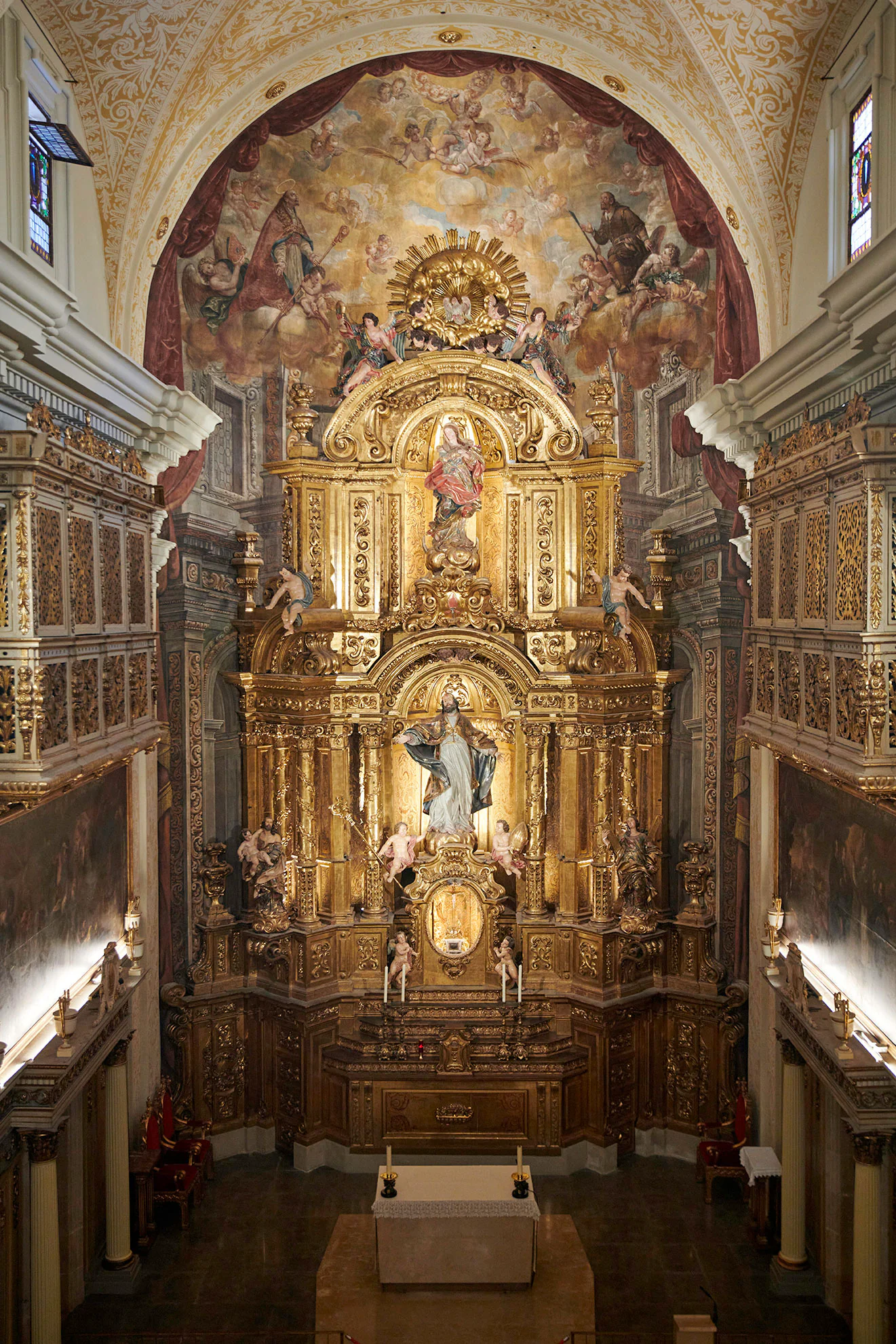
The Church of Sant Sever (Saint Severus), located next to the Barcelona Cathedral, is one of the city’s best-preserved Baroque spaces, having escaped destruction during the Civil War. Built based on a design by Jaume Arnaudies (1698) and completed by Joan Fiter, it features a single-nave structure with three side chapels on either side, a choir, and a polygonal apse. The exterior façade was designed by Jeroni Escarabatxeres (1703).
The church was built to serve the Community of Beneficiaries of Sant Sever —a permanent group of priests working at the Barcelona Cathedral—, an institution that remained active until the late 1960s. The church’s size and the beauty of the complex have made it a popular place of worship for family celebrations, particularly weddings and birthdays. It is currently managed by the Cathedral Chapter of Canons.
The interior consists of an open nave featuring an upper gallery of tribunes with latticework screens. The walls and vaults are decorated with vegetal and floral sgraffito work by Escarabatxeres.
The high altarpiece was erected in the mid-18th century based on a design by Pere Costa Cases and stands as a masterpiece of Catalan Baroque altarpiece art. The most remarkable feature of the ensemble is the apse painting, executed on canvas using the trompe-l’œil technique; the work originated from the workshop of Antoni Viladomat (and was very likely created by the Tramulles brothers). Of particular note is the depiction of the glorification and triumph of Saint Severus and Saint Medir.
Above the doorways leading to the church’s adjacent spaces hang two narrative paintings attributed to Joan Gallart (1701). One of them —perhaps the most notable— depicts the martyrdom of Saint Severus at Castrum Octavianum, featuring a central image of the Bishop of Barcelona at the hands of his executioner. The other, which is more landscape-oriented in style, depicts the miracles of Saint Severus in Collserola: both the miraculous spring of water and the growth of the broad beans.
The remaining altarpieces, located in the side chapels, date from a later period (the late 18th or early 19th century). Notable figures among them include Saint Peter and Saint Paul, Saint Raymond Nonnatus, Saint Mary Magdalene, and Saint Joseph Oriol.
Finally, the set of stained-glass windows commissioned from Francesc Saladrigues —one of the era’s most distinguished stained-glass masters— deserves special mention, particularly the rose window on the main façade.